Synopsis
The VR piece begins in a corrupted replica of the installation space. The participant is pulled out through the gallery's entrance, which reconstitutes itself as the doors of a mountain chapel. In this world, monumental structures and fractured figures manifest as mere surfaces, held together by plays of light. Reflections and refractions are decoupled from their surroundings, and the artifacts of warping, clipping, and degradation remain visible. Atmospheric conditions and accelerated day/night cycles are randomized at each run—no two simulations share the same pattern of visibility.
Guided by a series of psychopomps, the participant descends through four tiers of the floating landscape, before rising again to a new vantage point. The route cannot be altered; what remains free is the beam of a flashlight, the direction of the gaze, and the body itself, which registers vertigo, scale shifts, and falls in its own vestibular system.
At the peak of the ascent, the participant is engulfed by a city-sized egregore, which emerges from beneath the Tower of Babel.
Exhibited: Matter as Fallen Light, curated by Kaegan Sparks, Anna-Maria and Stephen Kellen Gallery, New York, 2023
Collection: The New School Archives and Special Collections, New York

AI Model Trainer: Art & Philosophy (2024-2025)

Subject-matter expert
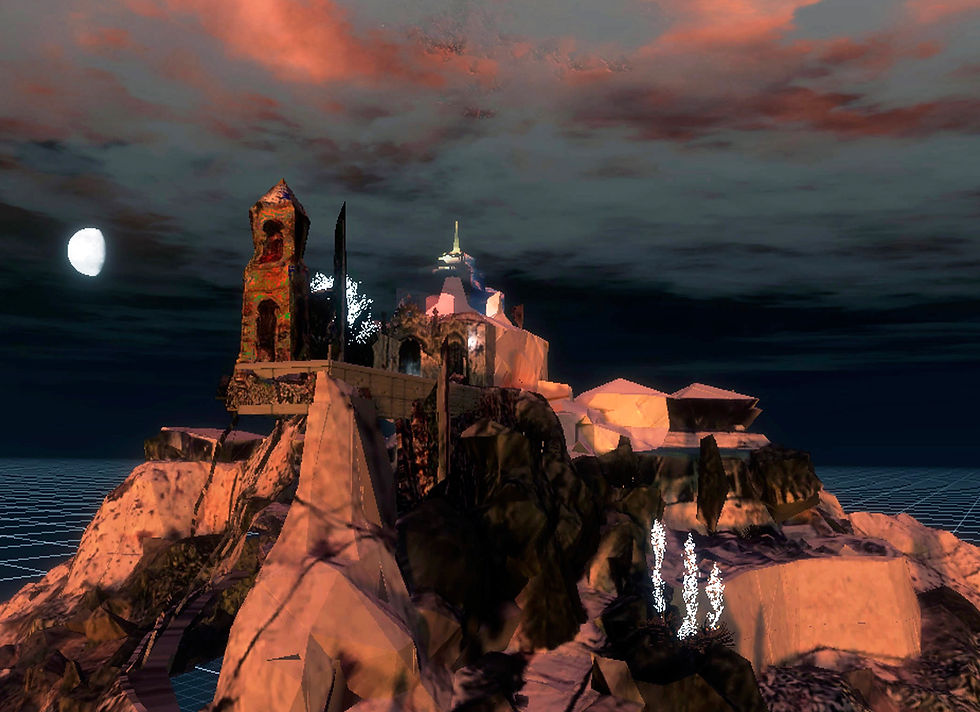


SELECTED STILLS

Full Guided Capture
This video documents the complete guided route through the VR experience, but not the headset’s embodied scale, interactions, or vestibular effects.
Navigable Level Demo

This downloadable demo opens one tier of the environment for desktop-based, open-world exploration.
Windows only. No VR headset required.
Installation Interface
The tethered headset and controller are installed on a small circular table among a mass of partially-melted candles coated in retro-reflective glass beads and broken safety glass. The wax construction is centered around a ceramic tile, which recurs throughout the VR environment as a texture and architectural motif.
A silicone cast of the artist's closed eyes is affixed to the front of the headset, while silicone fingers wrap the sole handheld controller—both casts are embedded with the same glass beads as the wax. The participant is seated before the installation in an industrial swivel chair. For the duration of their time in the headset, a single candle is lit and allowed to burn, memorializing the visitation with a residue and a witness.
The installation’s arrangement corresponds to the opening scene of the VR piece, providing a physical-virtual threshold. In future installations, this opening scene would be reconfigured for the new exhibition site.
TECHNICAL SPECS: Unity, 2023. Meta Quest 2, PC-tethered with right-hand controller;
seated experience, 360° swivel; spatial audio via headset speakers. Docent required.


Background Research
The VR apparatus is approached as a phenomenological intervention in the sensory field: it engulfs participants in the experiential "object" of the artist's externalized subjectivity.
Primary references:
-
The membrane that separates an organism from its environment and governs all exchange across it (Freud's protective shield, the cell wall)
-
Systems that persist by steering against entropy (Wiener, Bateson)
-
The individuation of form out of a pre-individual field (Simondon)
-
The eschatological structures (katabasis, psychopomps, egregores, Babel) through which cultures stage dissolution and return
The terrain was scraped from the arcs of a rotating Google Maps viewfinder and converted, through a chain of programs, into formats Unity can read. Each conversion degrades the data further from its source. The tiered landscape is autobiographical geography—Athens, New York, Bali; interiors rebuilt from memory, public documentation, and personal photographs. Its construction extends the clinical use of VR as exposure therapy, turning the medium's capacity to place a body in a controlled reconstruction of a charged environment toward sites from the artist's own history.

View full index